

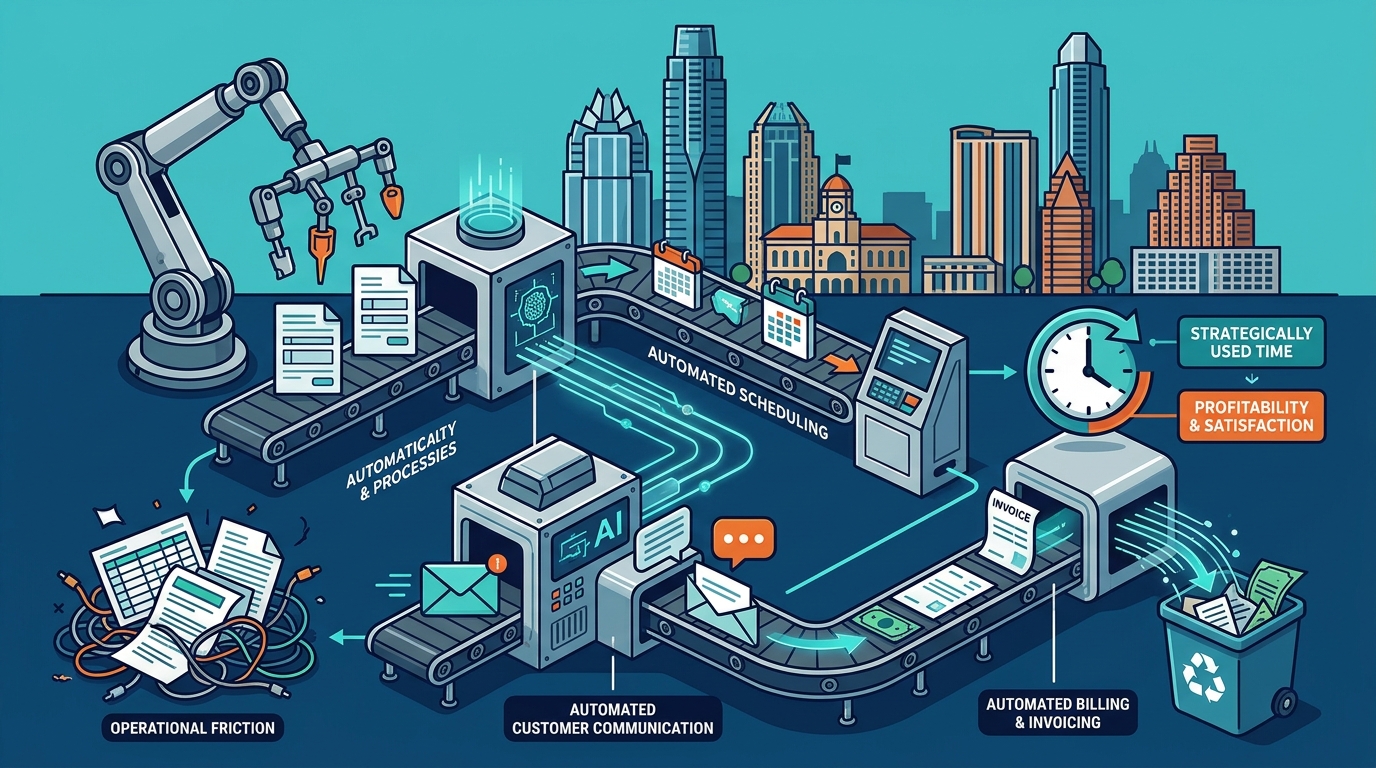
AI workflow automation is the use of artificial intelligence to execute repetitive business tasks without manual intervention. For Austin businesses, this technology reduces operational friction by handling data entry, scheduling, and customer communication automatically. By integrating these systems, local companies can reclaim hours of labor weekly, allowing teams to focus on strategic growth rather than administrative overhead. This shift is particularly valuable in the competitive Austin market, where efficiency directly impacts profitability and customer satisfaction.
Identifying High-Impact Automation Opportunities
Before deploying AI, businesses must identify which processes consume the most time and offer the highest return on investment. The first step is mapping current workflows to pinpoint bottlenecks. For example, a local service provider might find that 30% of their week is spent manually updating job statuses in a spreadsheet. This specific data point highlights a clear target for automation. By focusing on high-volume, low-complexity tasks, companies can achieve quick wins that build internal confidence in the technology. For additional details, review the Car Brands Serviced in.
The evidence for this approach lies in the measurable reduction of human error. Manual data entry is prone to typos and inconsistencies, which can lead to costly mistakes in billing or inventory. AI systems process data with near-perfect accuracy, ensuring that downstream tasks receive clean inputs. The implication is a more reliable operational foundation. When data is accurate, decision-making becomes faster and more trustworthy. This reliability is crucial for businesses operating in the fast-paced Austin tech and service sectors. For additional details, review the Auto Repair Services in.
Integrating AI with Existing Tech Stacks
Successful automation requires seamless integration with the tools a business already uses. Most Austin companies rely on a mix of cloud-based software for accounting, project management, and customer relationship management. AI agents can act as a bridge between these platforms, moving data automatically from one system to another. For instance, when a new lead is captured on a website, an AI workflow can instantly log the contact in the CRM and send a personalized follow-up email. This named entity, the CRM, becomes a central hub for automated interactions rather than a manual data entry point.
The evidence for this integration strategy is found in the reduction of software silos. When systems are disconnected, employees waste time switching between applications and re-entering information. AI middleware eliminates this friction by creating a unified data flow. The implication is a smoother user experience for employees. When tools talk to each other, staff spend less time navigating software and more time executing their core responsibilities. This efficiency gain is often the most immediate benefit reported by businesses adopting AI workflows.
Enhancing Customer Experience with AI
AI automation is not just about internal efficiency; it significantly improves the customer experience. In Austin, where service expectations are high, rapid response times are a competitive advantage. AI chatbots and automated email systems can provide instant answers to common customer questions, such as business hours or service availability. For example, a local retailer can use AI to handle 80% of routine inquiries, freeing human agents to address complex issues. This specific metric demonstrates the scalability of AI in customer support.
The evidence for this customer-centric approach is the increase in customer satisfaction scores. When customers receive immediate, accurate responses, their perception of the brand improves. AI systems can also personalize interactions by analyzing past purchase history or communication preferences. The implication is stronger customer loyalty. In a market with many alternatives, the businesses that respond fastest and most personally often win. AI enables this level of responsiveness at a scale that human teams alone cannot achieve.
Measuring ROI and Continuous Improvement
To justify the investment in AI automation, businesses must track key performance indicators. Time saved, error reduction rates, and cost per transaction are essential metrics. For instance, a marketing team might track the time spent creating social media posts before and after implementing an AI content assistant. If the time per post drops from two hours to twenty minutes, the ROI is clear. This concrete example provides a tangible benchmark for success.
The evidence for continuous improvement lies in the iterative nature of AI systems. As workflows evolve, automation rules must be updated to reflect new processes. Regular reviews of automation performance ensure that the system remains aligned with business goals. The implication is a culture of data-driven decision-making. By constantly measuring and refining, businesses can identify new opportunities for automation. This ongoing optimization ensures that the AI investment continues to deliver value over time.
Key Takeaways
- AI workflow automation reduces manual labor by handling repetitive tasks like data entry and scheduling.
- Identifying high-volume, low-complexity processes is the best starting point for automation.
- Seamless integration with existing software stacks is critical for successful implementation.
- AI enhances customer experience by providing instant, personalized responses to inquiries.
- Tracking metrics like time saved and error rates is essential for measuring ROI.
- Continuous monitoring and refinement of AI workflows ensure long-term value.
Frequently Asked Questions
What is AI workflow automation?
AI workflow automation is the use of artificial intelligence to execute repetitive business tasks without manual intervention.
How much time can AI save a business?
Businesses often save 10 to 20 hours per week per employee by automating administrative tasks.
Do I need to replace my current software?
No, AI tools typically integrate with existing software to create a unified data flow.
Is AI automation only for large companies?
No, small and medium-sized businesses can benefit significantly from AI automation.
How do I measure the success of AI automation?
Track metrics such as time saved, error reduction rates, and cost per transaction.
Conclusion
AI workflow automation offers Austin businesses a powerful tool to enhance efficiency and customer satisfaction. By identifying high-impact processes, integrating with existing tech, and measuring results, companies can achieve significant time savings. RBK Auto Tech understands the importance of efficiency in the automotive industry, and we encourage local businesses to explore how AI can streamline their operations. To learn more about how we support local businesses with reliable service and technology, visit our About Us page.