

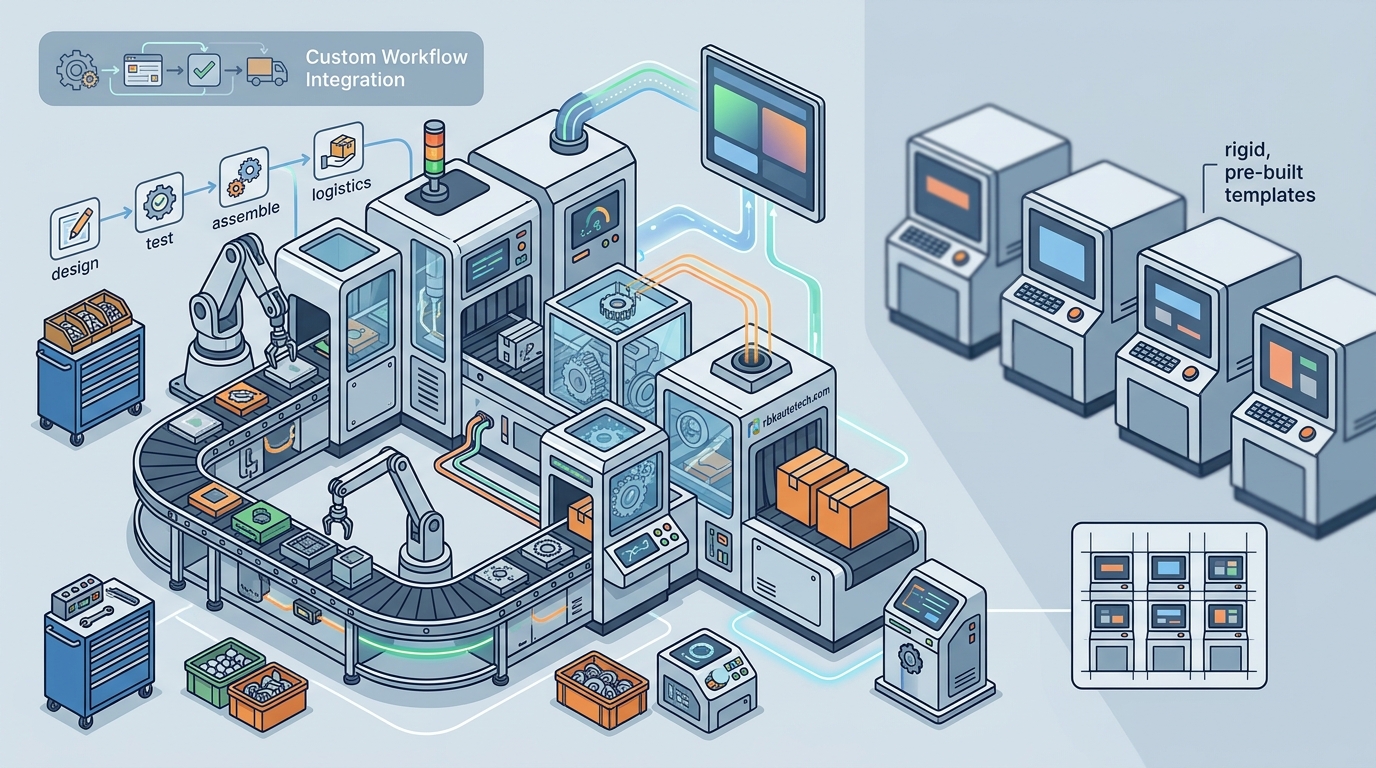
Custom automation is the superior choice for clients needing tailored workflows because it adapts to unique business logic rather than forcing operations into rigid, pre-built templates. This guide covers workflow automation, business process integration, custom software development, and bespoke solutions. It explains how to evaluate system integration needs and select the right approach for long-term scalability. For additional details, review the Contact RBK Auto Tech.
Workflow Automation
Workflow automation is the use of technology to execute repetitive tasks without manual intervention. Standard software often provides pre-set workflows that work well for common scenarios but fail when business logic diverges from the norm. For clients with unique operational needs, standard tools create friction. Custom automation removes this friction by building logic that matches the exact sequence of operations required. For additional details, review the Car Brands Serviced in.
Limitations of Standard Templates
Standard platforms rely on generic templates. These templates assume a linear process. When a client's process involves conditional branching, complex approvals, or non-standard data handling, standard tools require workarounds. These workarounds increase error rates and maintenance costs. Custom automation avoids this by coding the specific logic from the start. For additional details, review the Auto Repair Services in.
When Custom Logic Wins
Custom logic is necessary when the business process is a competitive advantage. If the workflow is unique, standard software cannot replicate it efficiently. Building a custom solution ensures that the automation mirrors the business exactly. This alignment reduces training time and minimizes user error. For additional details, review the Tire Services in Sacramento.
Business Process Integration
Business process integration is the connection of disparate systems to share data and trigger actions. Standard software often operates in silos. It may handle one function well but fail to communicate seamlessly with other tools. Custom integration bridges these gaps. It allows data to flow between legacy systems, modern APIs, and internal databases without manual entry.
The Cost of Data Silos
Data silos create inefficiencies. Employees must re-enter data across multiple platforms. This duplication leads to inconsistencies. Custom integration solves this by creating a unified data layer. It ensures that every system sees the same information in real time. This consistency is critical for accurate reporting and decision-making.
API-First Integration Strategies
Modern integration relies on Application Programming Interfaces (APIs). Custom developers can build robust API connectors that standard software may lack. These connectors handle complex data transformations. They ensure that data from one system is formatted correctly for another. This level of control is only possible with custom development.
Custom Software Development
Ownership and Control
Long-Term Cost Considerations
Custom software has a higher initial cost. However, it often reduces long-term expenses. Clients avoid paying for unused features. They also avoid vendor lock-in. The total cost of ownership can be lower over time. This is especially true for businesses with complex, stable workflows.
Custom Workflow Automation
Custom workflow automation is the design of automated processes that reflect unique business rules. It goes beyond simple task scheduling. It involves building decision trees, exception handling, and dynamic routing. This approach is ideal for clients whose workflows change based on context. Standard tools struggle with dynamic logic. Custom automation handles it natively.
Dynamic Decision Trees
Many business processes are not linear. They involve multiple decision points. Custom automation can model these decision trees accurately. It can route tasks to the right people based on real-time data. This reduces bottlenecks and speeds up processing. Standard tools often require manual intervention at these points.
Exception Handling
Exceptions are inevitable in any business process. Custom automation can define specific responses for each exception. It can alert the right team, log the issue, and suggest a resolution. This proactive handling prevents small issues from becoming major problems. Standard tools often lack this granularity.
System Integration
System integration is the process of combining different software systems into a cohesive whole. It ensures that data flows smoothly between applications. For clients with a mix of legacy and modern systems, integration is critical. Custom integration solutions can connect systems that standard software cannot. This creates a unified operational environment.
Legacy System Challenges
Legacy systems are often difficult to integrate. They may lack modern APIs or documentation. Custom developers can build adapters to bridge these gaps. These adapters translate data between old and new systems. This allows businesses to modernize gradually without replacing everything at once. This phased approach reduces risk and cost.
Real-Time Data Synchronization
Real-time synchronization is essential for many operations. Custom integration can achieve this by building event-driven architectures. When data changes in one system, it is immediately updated in others. This eliminates delays and inconsistencies. Standard tools often rely on batch processing, which can be too slow for dynamic environments.
Bespoke Software Development
User Experience and Adoption
User adoption is a common challenge with standard software. Employees may resist using tools that do not fit their workflow. Bespoke software is designed around the user. It reduces the learning curve. This leads to higher adoption rates and better productivity. A well-designed interface can make complex tasks feel simple.
Scalability and Future-Proofing
Bespoke software can be built with scalability in mind. It can handle increased data volumes and user loads. It can also be updated to incorporate new technologies. This future-proofing ensures that the software remains relevant as the business grows. Standard software may reach its limits, requiring a complete replacement.
Comparison of Automation Approaches
| Initial Cost | Low | Medium | High |
| Flexibility | Low | High | Very High |
| Time to Deploy | Fast | Medium | Slow |
| Vendor Lock-in | High | Low | None |
| Scalability | Limited | Good | Excellent |
| Best For | Standard Processes | Unique Workflows | Complex, Evolving Needs |
Key Takeaways
- Custom automation is superior for clients with unique, non-standard workflows.
- Standard software creates friction when business logic diverges from generic templates.
- Business process integration requires custom solutions to bridge data silos.
- Custom software development offers full ownership and control over the codebase.
- Custom workflow automation handles dynamic decision trees and exceptions effectively.
- System integration is critical for connecting legacy and modern systems.
- Bespoke development provides the highest level of personalization and scalability.
- The choice between standard and custom depends on the uniqueness of the business process.
Frequently Asked Questions
Is custom automation always more expensive than standard software?
How long does it take to build a custom workflow?
The timeline varies based on complexity. Simple workflows may take weeks. Complex systems may take months. A phased approach can deliver value faster by prioritizing critical processes.
Can standard software be modified to fit unique workflows?
Standard software can be configured, but it has limits. If the workflow requires significant changes to the core logic, standard software will struggle. Custom automation is better for these cases.
What is the difference between custom and bespoke software?
Custom software is tailored to specific requirements. Bespoke software is highly personalized, often including unique user interfaces and deep integration. Bespoke is a subset of custom development with a focus on fit.
How do I know if my workflow is unique enough for custom automation?
If you find yourself constantly working around standard software limitations, your workflow is likely unique. Evaluate the time and cost of these workarounds. If they are significant, custom automation may be worth it.
Can custom automation integrate with existing systems?
Yes. Custom automation is designed to integrate with existing systems. It can connect to legacy applications, modern APIs, and databases. This integration ensures a seamless operational environment.
What are the risks of custom software development?
The main risks are scope creep and vendor dependency. Mitigate these by defining clear requirements and ensuring code ownership. Choose a reputable development partner to minimize risk.
Is custom automation suitable for small businesses?
Yes, if the workflow is a core part of the business. Small businesses with unique processes can benefit from custom automation. It can provide a competitive advantage by streamlining operations.
Conclusion
Choosing between standard software and custom automation depends on the uniqueness of your workflow. If your process is standard, off-the-shelf tools may suffice. If your workflow is a competitive advantage, custom automation is the better choice. It provides the flexibility, integration, and control needed to scale. For clients in Sacramento and beyond, RBK Auto Tech offers the expertise to evaluate your needs and recommend the right solution. Contact us to discuss how custom automation can transform your operations.